Top Signs You Need Garage Door Service – Don’t Ignore These
A garage door that takes three seconds longer to open than it did six months ago isn’t “getting old.” It’s telling you the spring tension is running low and the opener motor is working harder to compensate. Most failures announce themselves well before anything breaks: a new sound, a shifted speed, a door that no longer stays put when you stop it halfway. The trouble is that we’re all used to treating those signals as normal wear. Here’s how to read them in New Haven before a cheap fix turns into an expensive one.
None of this requires tools. It requires paying attention for a couple of minutes a month. And if a symptom sounds serious, call (866) 476-7578 and we’ll tell you what we think.
Why Garage Doors Give Warning Signs Before They Fail
Garage doors fail gradually, not suddenly. The moving parts – springs, cables, rollers, drums, hinges – wear against each other every single cycle, and the wear shows up as changes you can hear and see. A door that runs cleanly is quiet, moves at a steady speed, and stays exactly where you leave it. A door that’s drifting toward failure does something slightly different every week.
The problem is that “slightly different” gets normalized fast. We’ve seen doors where the owner had been lifting a heavy door by hand for months and assumed that was just how it was now. Catching a worn cable with a quick inspection is one kind of bill. Catching it after it snaps and the door drops off its track is another.
New Haven homes tend to have a lot of older doors in service, and older doors run on tired hardware. The good news is that almost every failure mode has a clear signal. You just have to know what you’re listening for.
1. The Manual Balance Test: What a Balanced Door Actually Feels Like
This is the single most useful check a homeowner can do, and it takes about thirty seconds. With the door closed, pull the opener’s release cord so the door runs on its springs alone. Lift it halfway by hand and let go. Then lift it a quarter of the way and let go again.
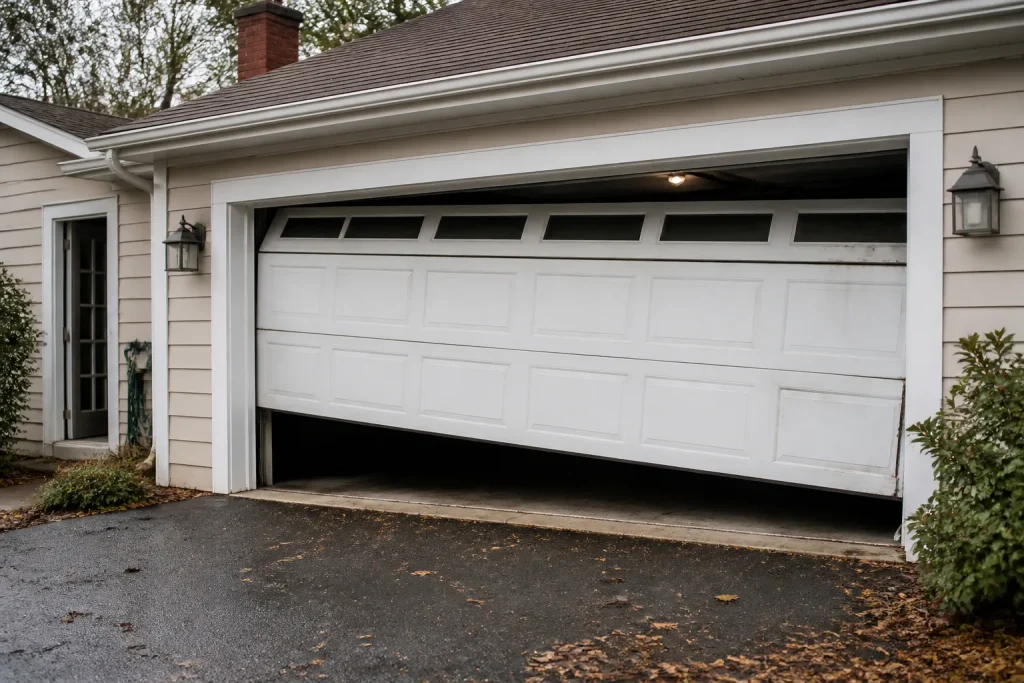
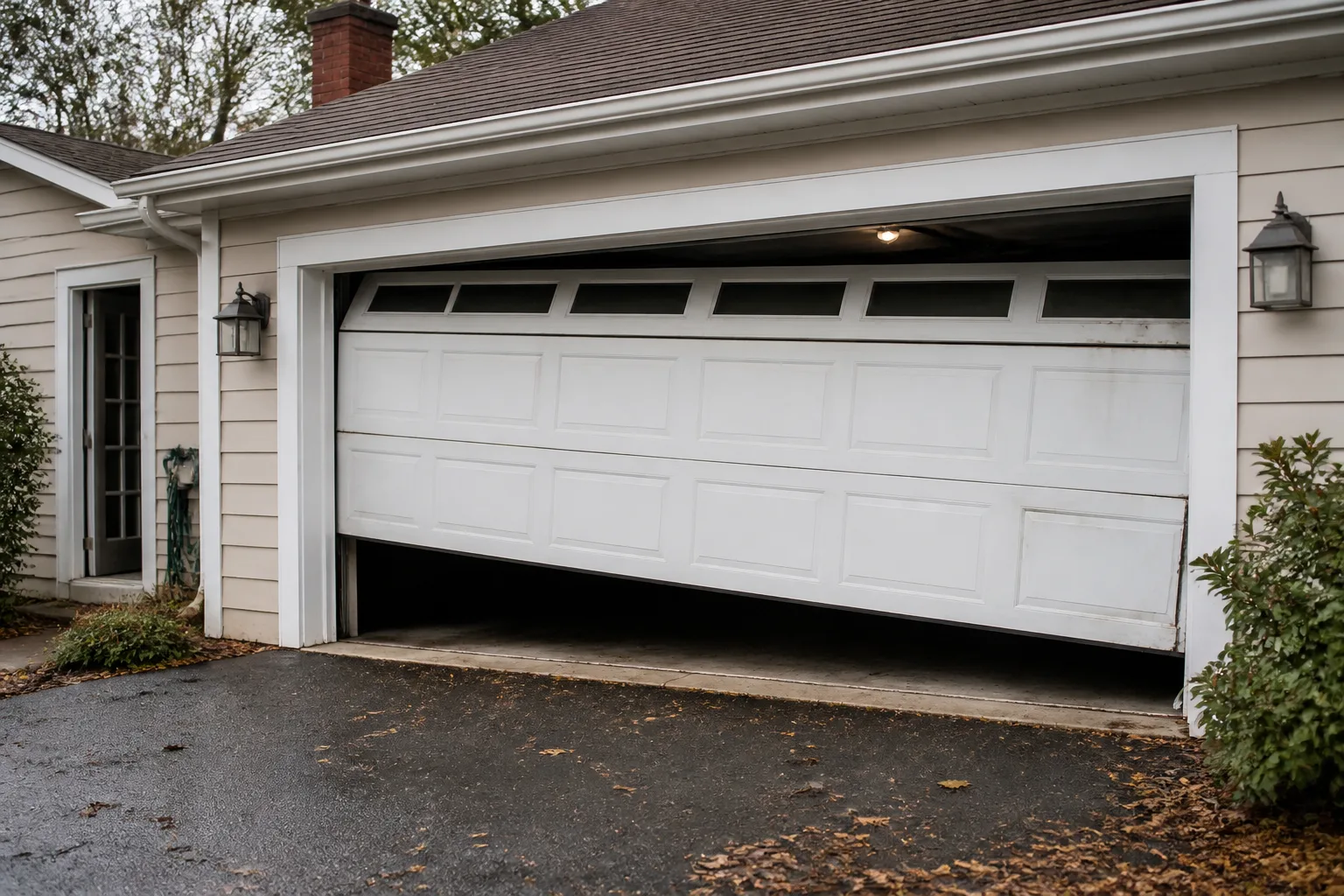
A balanced door stays put at roughly any height you leave it. That’s what “balanced” feels like: no drudgery lifting, no door trying to slide away from your hand. If it drifts down on its own from halfway, the springs aren’t holding the door’s weight, and that’s a problem with tension or spring condition, not a quirk.
How far it drifts tells you how urgent it is:
- Stays in place or drifts an inch or two: normal, within tolerance.
- Drifts several inches to a foot before stopping: tension is under spec and the opener is covering for it. Worth a look soon.
- Falls steadily to the floor: the spring is close to the end of its useful life. Stop using the door.
- Feels extremely heavy lifting by hand: same answer – stop, and call.
A word on safety before you try this at home: never adjust the springs or cables yourself. They’re under high tension, and the hardware can injure you badly if it releases unexpectedly. Our technicians have up to 9 years of experience with exactly this work, which is why garage door spring repair stays in-house rather than being handed off. In New Haven, the balance test tells you what’s happening. Leave the wrench to someone trained for it.
2. The Sound Taxonomy: Every Noise Points at a Different Part
Your door has a vocabulary. Most noises fall into four recognizable categories, and each one points at a different component:
- A grinding or squealing noise that follows the door up and down: usually a dry roller or a dry hinge. This is a lubrication issue, and it’s the cheapest kind of problem to catch. Left alone, a dry roller flattens and starts chewing into the track.
- A popping or clicking from the top corners of the door: that’s the cable drum. A drum that’s popping usually means a cable is beginning to fray or has jumped its groove. This one matters. A cable that fails under tension can leave a door hanging crooked, and it’s worth stopping use until it’s looked at.
- A rhythmic scrape, once per rotation: debris in the track, or a track that’s bent out of line. If it scrapes at the same spot every revolution, something is in the path. If it scrapes the whole way up one side, the track is likely out of alignment.
- A sharp snap, then silence: spring failure. It usually sounds like a gunshot from the garage and the door immediately becomes very heavy or won’t lift at all. Don’t try to force it open. This is the classic case where garage door repair becomes urgent.
New Haven homes with attached garages tend to muffle these sounds, so listen at the door itself rather than from inside the house. What sounds like a minor rattle through a wall is often clearer standing in the driveway. Learn four sounds and you’ll know roughly what part is talking.
3. Visual Wear Signs You Can Spot Without Any Mechanical Knowledge
You don’t need to understand garage door mechanics to spot wear. A few visual checks tell you plenty, and all of them can be done from the floor with the door closed or halfway open:
- Hinge knuckle gaps. Look at the hinges between panels. If the metal knuckles are wallowed out or sitting with visible gaps, the hinge is worn and the panels are shifting against each other as the door moves. Worn hinges eventually distort panels.
- Cable rust staging. Cables start bright, dull to a brown-gray, then show pitting and loose strands. Light dulling is fine. A cable that looks fuzzy, birdcaged, or rusted at the bottom drum is on its way out.
- Roller tire cracking. Rollers have a tire-like wheel that rides in the track. Cracks, flat spots, or a wheel that won’t spin freely by hand all mean replacement. Rollers are inexpensive and replaceable before they damage the track.
- Bottom seal compression failure. The rubber seal along the bottom should look even all the way across. If it’s crushed on one side and barely touching on the other, the door isn’t sitting level, which usually traces back to the springs or cables.
A quick walk-around after any storm season is good practice in New Haven. It’s also the time to check the door and tracks for dents or debris from windblown branches, which tend to show up after a rough stretch of weather.
4. When the Opener Is the Messenger, Not the Problem
A motor that runs longer than it used to, reverses for no clear reason, or needs two or three button presses to get moving is usually telling you the door is heavy – not that the opener is broken. The opener is doing exactly what it’s built to do: compensating by generating more force to move a door that’s harder to move. On a LiftMaster or Chamberlain unit, the motor’s extra effort often comes with a slightly different sound and a longer travel time, which is easy to mistake for an opener fault.
Before you replace a Genie, Craftsman, or Chamberlain opener, rule out the door itself. A door running on weak springs will wear out any opener you put on it. Our experience across those brands means we check the door’s balance and travel before assuming the motor is at fault. Diagnosing by brand behavior, rather than guesswork, saves homeowners from replacing a healthy opener twice.
If the door is balanced and the opener still stumbles – fails to complete a cycle, reverses mid-travel, or ignores the remote – that shifts the diagnosis toward the motor, limits, or safety sensors. That’s the moment to look at garage door opener repair rather than the door hardware.
5. The Seasonal Pattern: Why March and November See the Most Failures
Garage door failures cluster. In New Haven, March and November are the two months we hear the most from. It isn’t superstition. It’s how the seasons treat the springs.
Springs work harder in cold weather. The metal gets stiffer, the grease thickens, and the door fights the opener a little more on every cycle through the winter. By March, a spring that was marginal in October has spent months at the edge of its travel. The bottom seal takes a similar beating, compressing unevenly against a cold, heaving floor and often not reseating fully when the thaw comes.
November is the reverse edge. That’s when the first hard cold hits and old parts that ran fine all summer suddenly don’t. Cables that were merely dulled get brittle. Doors that were slightly out of balance all year now drift or stall.
What to inspect coming out of winter: run the manual balance test once, listen for any new sound, check the bottom seal line, and look at the cables and rollers. Five minutes in the driveway each spring catches the wear while it’s still a small fix. It’s the best way to keep a garage door working across all four seasons.
When to Call a Pro
Lubricating rollers and spot-checking seals are homeowner jobs. Springs, cables, and drums are not. Once you see a drifting door, a popping drum, a frayed cable, or a snap-then-silence, stop and call. We work on all the major brands – LiftMaster, Chamberlain, Clopay, Amarr, and the rest – so the diagnosis starts with the right questions instead of a new door you may not need.
Related services in New Haven
If you’ve spotted any of these signs and want a hands-on look, start with garage door repair, or reach out for a full door inspection if you’re not sure which part is talking. If the door itself is beyond repair, we also handle complete installation, so one call covers it. When your door fails at an awkward hour, emergency service is part of what we offer, not a special exception.
The Bottom Line
Your door is communicating constantly, and every signal has a meaning: a drift in the balance test, a specific sound, a visible wear sign, or an opener that’s working harder than it should. Reading those signs early in New Haven keeps a fifteen-minute service from turning into a full repair. The manual balance test is the one to run first; it’s the quickest way to know whether your springs are up to spec.
If you’re in New Haven and need help, New Haven Garage Door Repair Co offers free estimates – call (866) 476-7578. We’ll tell you what the door is saying and what it takes to get it back to working order.
Frequently Asked Questions
A door that no longer stays where you leave it is the earliest reliable sign. Run the manual balance test: pull the release, lift the door halfway, and let go. If it drifts down on its own, the springs are under tension and the door needs a look.
No. Garage door springs are under high tension and can cause serious injury if they release unexpectedly. The balance test is a safe check for a homeowner; adjusting the springs should be left to a trained technician.
Usually not. A slow opener often means the door is hard to move, and the motor is compensating. Check the door’s balance first. If the door is balanced and the opener still stumbles, then it’s worth looking at the opener itself.
March and November are the two peak months. Cold weather stiffens springs, thickens grease, and stresses cables that were already near the end of their life. A quick spring inspection just before and just after winter catches most of the wear.
Written by the team at New Haven Garage Door Repair Co.
Need Garage Door Help?
Call New Haven Garage Door Repair Co - the local pro we connect you with is licensed and insured, here with fast after-hours help in New Haven.
(866) 476-7578